Thursday, September 2, 2021

Skousen on witnesses-Part 2

This is the second section of my peer review of Royal Skousen's very important analysis of witness statements, published in the Interpreter here.

https://interpreterfoundation.org/blog-update-of-the-pre-print-of-a-discussion-of-the-book-of-mormon-witnesses-by-royal-skousen/

Page 9. This section is the most important of the book: Two different methods of translating the Book of Mormon. 

Skousen presents U&T as the method Joseph used for the 116 pages, followed by a transition to SITH, followed by SITH as the only method used to translate the text we have today. In doing so, he omits statements that contradict his theory, including those by Lucy Mack Smith.

Skousen starts off by explaining his bias, which I appreciate because so many authors don't explain their biases.


It's good of Skousen to qualify his claim by writing "most probably all translated by means of a seer stone." That leaves open the possibility that Joseph actually translated with the Urim and Thummim after all (although Skousen doesn't use the term here). 

However, he then constrains himself by accepting that possibility only with regard to the 116 pages.

Next, he discusses the relevance of the curtain or blanket.


The curtain narrative has been largely overlooked. It's a good example of something that was so commonly understood that few people bothered to write it down or mention it later. Sometimes what is not said is as important as what is said. People often don't mention the obvious. No one recorded that Joseph breathed oxygen, either; breathing was not remarkable or unusual. 

And yet, the entire premise of the 1834 book Mormonism Unvailed was to figure out what was behind the "vail." Aside from the title, the book uses the term "unvailed" only once, on page 278.

"We proposed in the commencement of this work, to give to the world all the light, of which we were in possession, as to the real and original author or authors of the Book of Mormon. That there has been, from the beginning of the imposture, a more talented knave behind the curtain, is evident to our mind, at least: but whether he will ever ben clearly, fully, and positively unvailed and brought into open day-light, may of course be doubted."

The book then proceeds to describe the Spalding theory, which proceeded to dominate the narrative among nonbelievers. Obviously, the Spalding theory was feasible only if Joseph was dictating the text from behind a curtain, screen, or "vail." The books ridicules the other explanation--that Joseph dictated while reading words off a stone, or, alternatively, off the Urim and Thummim--pointing out that in such an event, there was no point in having the plates in the first place and the witnesses to the plates were irrelevant.  

Joseph Smith explained that Moroni had warned him not to let anyone see the plates.

Again, he told me, that when I got those plates of which he had spoken—for the time that they should be obtained was not yet fulfilled—I should not show them to any person; neither the breastplate with the Urim and Thummim; only to those to whom I should be commanded to show them; if I did I should be destroyed. (Joseph Smith—History 1:42)

This leaves us with one of two options. Either (i) Joseph translated the plates with the Urim and Thummim and dictated from behind a screen or (ii) he did not, and the warning about not showing the plates and Urim and Thummim was pointless. 

Here, I need to explain the acronym SITH. Because there are accounts of Joseph using both a stone in the hat and spectacles in the hat, I use the acronym SITH for both scenarios. Statements regarding "spectacles" not only don't necessarily refer to the Urim and Thummim, but they cannot refer to the Urim and Thummim, because Joseph was forbidden to display the Urim and Thummim until after the translation was complete and there is no account for an exception. Statements about "spectacles" represent (i) confusion with the stone, (ii) assumptions that the stone came from the Urim and Thummim, or (iii) speculation about what was behind the screen.

As we'll see, all we can tell from the SITH witnesses is that Joseph dictated something out in the open, where witnesses could observe. What we can't tell is whether what he dictated ended up in the text of the Book of Mormon, or even whether he was "translating" in any sense of the word during those open sessions.

With this in mind, we can see the logical fallacy of Skousen's conclusion.


Regarding the first highlighted sentence, I've proposed elsewhere that the original manuscript does tell us (or at least offers clues) that the open session David Whitmer described had to involve Second Nephi. We'll get into the details when we reach David's statement, but briefly, David says three scribes were at the table, taking turns as they tired, and that Emma was one of the scribes. Emma arrived some time after Joseph and Oliver, and her handwriting is not on the extant OM (mainly 1 Nephi). The scribes who wrote 1 Nephi did not write briefly and take turns; they wrote several pages at a time. The evidence therefore indicates that Joseph dictated 2 Nephi rapidly.

The second highlighted section is the logical fallacy. Despite the SITH witnesses, there is no evidentiary or logical reason why Joseph could not have used the Nephite interpreters to translate the plates. None of the SITH witnesses claimed to be present during the entire translation in Harmony and Fayette, leaving plenty of opportunity and time for Joseph and Oliver to work with the Urim and Thummim. And, of course, Joseph and Oliver both claimed that Joseph translated by means of the Urim and Thummim. 

_____

Next, Skousen repeats two common but obvious errors. I haven't taken the time to find out where these errors originated, but they are ubiquitous, especially since they were perpetuated in the Gospel Topics Essays.
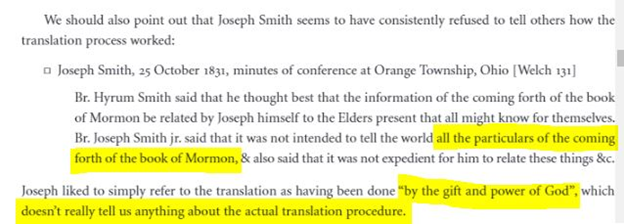

Error #1. Hyrum did not ask about the translation. He asked about the "coming forth of the Book of Mormon." In response, Joseph explained it was not intended to tell the world "all the particulars of the coming forth of the Book of Mormon." 

The "coming forth" involved far more than just the translation, although the translation was certainly a significant element of the coming forth. Several of those present at the meeting did later discuss the translation, so they either did not think Joseph prohibited such a discussion or they directly violated his instructions.

In 1835, Joseph reported a conversation he had with a visitor, indicating that the "coming forth" began when he was around 6 years old.

He called to make enquiry about the establishment of the Church of the latter-day Saints and to be instructed more perfectly in our doctrine &c. I commenced and gave him a brief relation of my experience while in my juvenile years, say from 6, years old up to the time I received the first visitation of Angels which was when I was about 14, years old and also the visitations that I received afterward, concerning the book of Mormon, and a short account of the rise and progress of the church, up to this date.

Joseph Smith, Journal, 1835-1836 https://www.josephsmithpapers.org/paper-summary/journal-1835-1836/38

The two main accounts of the "coming forth" are found in Oliver Cowdery's eight letters and Joseph Smith-History. Neither of these accounts provides "all the particulars" about the ministering of angels, the obtaining and preservation of the plates, descriptions of the plates and other artifacts, whether there was one or two sets of plates, the visits to the repository in the Hill Cumorah (which Oliver later related, but not, as Brigham said, "in meeting," presumably recognizing Joseph's restraint), etc. 

Error #2. Joseph did not simply refer to the translation as having been done "by the gift and power of God." He and others often referred to the Urim and Thummim. Here are some examples.

Elders' Journal 1838[Moroni] being dead, and raised again therefrom, appeared unto me, and told me where they were; and gave me directions how to obtain them. I obtained them, and the Urim and Thummim with them; by the means of which, I translated the plates; and thus came the book of Mormon.

Wentworth Letter (Church history)Through the medium of the Urim and Thummin I translated the record by the gift and power of God.

Joseph Smith-History. Also that there were two stones in silver bows, and these stones fastened to a breastplate constituted what is called the Urim and Thummim, deposited with the plates, and the possession and use of these stones was what constituted seers in ancient or former times, and that God had prepared them for the purpose of translating the book.

“Latter Day Saints,” 1844: Through the medium of the Urim and Thummim I translated the record, by the gift and power of God.

Orson Pratt's 1840 pamphletMr Smith, who, by the gift and power of God translated them into the English language, by the means of the Urim and Thummim...

Times and Seasons editor (1 Sept 1842):  containing an account of the gospel in much plainness, being translated by the gift and power of God by the use of the Urim and Thummim,

Lucy Mack Smith: on the 22 of september I [Joseph] had the Joy and satisfaction of again receiving the ​urim and thummin into my possession and I have commenced translating

Lucy Mack Smith: Not far from this time, as Joseph was translating by means of the Urim and Thummim, he received instead of the words of the Book, a commandment to write a letter to a man by the name of David Whitmer, who lived in Waterloo; requesting him to come immediately with his team,

_____

In the next section, Skousen discusses what he calls "The first method: Using the Nephite interpreters along with the plates."

Here we have Joseph's account of copying and translating the characters "by means of the Urim and Thummim." We have John A. Clark's 1842 article relating what Martin Harris told him in 1828 regarding the "thick curtain or blanket ... suspended between them, and Smith concealed behind the blanket."

In both 1834 and 1841, Charles Anthon referred to the curtain that concealed Joseph from view, yet he also clamed Joseph "put on the spectacles occasionally, or rather, looked through one of the glasses." Left unexplained is how he (or Martin Harris) would know this if Joseph was concealed. The only possible answer is he (and Martin) related hearsay and/or assumptions.

These three accounts presumably originated with Martin Harris. Their existence suggests common knowledge that people didn't think they needed to record or report. 

The October 1831 statement attributed to Joseph Smith by Nancy Towle underscores the common understanding that Joseph had to have worked behind a screen. Joseph told her that in the box with the plates was "a pair of 'interpreters,' (as he called them,) that resembled spectacles; by looking into which, he could read a writing engraven upon the plates, though to himself, in a tongue unknown." Here Joseph explained he used both the Nephite interpreters and the plates, which had to take place behind a screen.

Beyond reporting these accounts, Skousen does not comment. And yet, he had just written a few pages previously that Joseph "consistently refused to tell others how the translation process worked." Here, Towle reported that Joseph explained he used the interpreters to look upon the plates, an explanation that Oliver Cowdery and Lucy Mack Smith corroborated--although inexplicably, Brother Skousen omitted their statements from this section. 

_____

Page 11. The next section is "Shifting from the first method to the second one."

We have Emma's 1870 letter to Emma Pilgrim in which she said Joseph used the Urim and Thummim for the part that Martin Harris lost, and then used a small stone. This vague letter answers a question we don't have because Pilgrim's letter is not extant. Emma's letter is useless as evidence. Emma does not even claim to be writing from personal knowledge or observation. Her letter would read identically if she was merely repeating hearsay--which she certainly was regarding the translation instruments, given the screen. Even if we infer she described the stone from personal observation, Joseph had the stone long before he translated anything so she had plenty of opportunity to observe it independent of any connection with the plates. Note that she doesn't directly say he translated with the stone, only that he "used" it. She doesn't specify times and places, another red flag for any witness' testimony. 

David's statement that Joseph translated first by the urim and thummim and afterwards by a seer stone is obvious hearsay. He was never present in Harmony for any of the translation events there. This has the tell-tale signs of coordinated testimony, coming as it did seven years after Emma's letter.

Martin Harris' statement about the seer stone vs. the Urim and Thummim is also obvious hearsay, given his statements about the curtain, but it is useful to disprove the recent scholarly narrative that early saints referred to the seer stone as the Urim and Thummim. Martin clarified that "the seer stone differed in appearance entirely from the Urim and Thummim that was obtained with the plates," evidently (but not explicitly) based on his experience seeing the Urim and Thummim as one of the Three Witnesses. Like Emma, Martin likely saw the seer stone in circumstances unrelated to the translation.

Aside from the problematic nature of these statements as reliable and credible evidence, the claim that Joseph didn't have or use the Urim and Thummim after the loss of the 116 pages contradicts what Joseph, Oliver, and Lucy Mack Smith said, and all of their statements are closer in time to the events in question. By Skousen's own standard, the statements in this section are comparatively unreliable. 

_____

Page 12. The next section collects statements about "The second method: Placing the seer stone in a hat in order to obscure the light."

The first paragraph is an unintentional list of logical and factual fallacies.


1. Instead of "all eight" witnesses saying what Skousen claims, not one of the eight witnesses said what he claims. Instead, each described discreet experiences in different places at different (and unspecified) times. Skousen strings their statements together to create an illusion of consistency and continuity.

2. Skousen claims these witnesses "independently" testified, as if each was unaware of what the others had said. Yet all of these witnesses knew one another. This is a classic set up for collusion and coordination. The inconsistency of terminology does not contravene the possibility for collusion because it is equally evidence of hearsay; i.e., they heard different things and mingled them in their respective memories.

3. Whether they explicitly state the seer stone was placed in a hat is a bit of a red herring. None of these witnesses reported what Joseph actually dictated during their observations. 

4. We can infer there was no curtain or blanket, whether the witnesses stated or implied that was the case--but that raises the question about why Joseph conducted a "translation" in public.

We'll discuss these points as we evaluate the witness statements.

_____

Refer to the original article to see the witness statements in full. Here we'll comment only on excerpts and commentary.

1. Joseph Knight Senior. Joseph Knight did not claim to be an eyewitness; his unsigned, undated statement is written mostly as hearsay. It relates historical events, such as Joseph going to the hill to get the plates, that he could not possibly have witnessed. There are parts of the statement in which Knight speaks from personal experience, such as "I paid him the money and I furnished him with a horse." He relates his personal experience staying at the Smith home the night when Joseph brought the plates home for the first time. He affirms that Joseph "was commanded not to let no one see those things." He relates Martin's trip to New York (obvious hearsay) and then describes the translation, but does not say he was present during the translation. Knight was pretty good about distinguishing between his direct observations and his hearsay recitations.

Later in the statement he explains that Joseph and his wife "came up to see me the first of the winter 1828" and Knight went down to see them in Harmony. Knight does say "Joseph talked with us about his translating" but he does not repeat what Joseph said and he does not attribute his description of the translation process to Joseph. Regarding the translation, Knight does not specify time and place. We don't even know when he wrote his statement, with the estimated range sometime between 1835 and 1847, 6 to 18 years after the fact. 

Here is Skousen's conclusion.


Recall that above, Skousen declared that Joseph Knight referred to the seer stone as the Urim and Thummim. Here he admits it's merely his assumption. And yet, in this same statement Knight tells us what Joseph saw "in his glass," which is obvious hearsay. Knight's statement might be useful if we're researching what people said about the translation, but it's useless testimony about actual facts because he did not personally observe Joseph's dictation and did not directly relate what Joseph told him..

2. Elizabeth Anne Whitmer Cowdery. This statement is merely a copy that William E. McLellin made on 15 February 1870 of an alleged statement Elizabeth wrote that is not extant. Part of the McLellin document is missing; Vogel and Welch offer different readings. 

By 1870, SITH was well entrenched. McLellin adamantly insisted that Joseph never had the Uirm and Thummim; he cited that as one of the reasons why he was no longer a Mormon and used Elizabeth's statement as supporting evidence. Whether he accurately copied Elizabeth's statement is anyone's guess, but the statement supports McLellin's view. I've shown elsewhere how her statement shares exact terminology with William Smith's 1883 statement and David Whitmer's 1887 statement, suggesting direct or indirect influence.

At the time of the translation, Elizabeth was 14 years old. She showed her statement to McLellin 41 years later, in 1870, when she and McLellin were both at David Whitmer's home in Richmond, Missouri. 

Like the other SITH statements, Elizabeth's is aimed directly at the Spalding theory. She emphasizes that Joseph never had a curtain drawn when she saw and heard them translate and write. But she does not give specific times and places (upstairs or downstairs?), and she doesn't even identify the scribe, which is odd if it was her future husband, Oliver.  

Elizabeth's statement says "he would place the director in his hat..." Skousen claims "the interpreters are sometimes referred to as directors" in the Book of Mormon (Alma 37:21, 24), but that claim cannot be verified because it's equally plausible that different terms refer to different items. 

3. Emma Smith Bidamon, "Last Testimony of Sister Emma." This interview by Emma's son Joseph Smith III has been dismantled elsewhere, so I won't take the time to do it here, other than to point out that Emma's testimony about the translation aims at refuting the Spalding theory, that it is vague and ambiguous because it doesn’t specify time and place, and it is questionable because of Emma’s claim that she “frequently wrote day after day” yet Joseph complained he had no one to write for him. Emma could have been referring to her scribal work on the 117 pages, the book of Mosiah, or 2 Nephi, but we have no way of knowing from her statement. As with the questions about polygamy in her Last Testimony, Emma’s answers about the translation are superficial and her son did not probe for details.

4. Michael Morse, Emma’s brother-in-law, reportedly claimed that he saw Joseph “engaged at his work of translation” which consisted of SITH, “and then dictating, word after word, while the scribe—Emma, John Whitmer, O. Cowdery, or some other, wrote it down.”

This interview took place in 1879, well after SITH had become established. Again, Morse did not specify time or place. It’s not clear how he could have been a witness at the Whitmer home in Fayette, but his listing of John Whitmer as a scribe excludes Harmony. Because he claims personal observation, it appears likely that he was present at the demonstration where three scribes took turns because Joseph dictated so fast they tired.

5. David Whitmer, interviewed by John Traughber Jr., October 1879. Traughber said David always related the same testimony, that Joseph used SITH and “read the translation as it appeared before him.” He also related the Whitmer hearsay that “a spiritual light would shine forth, and parchment would appear before Joseph,” etc. Of course, David never looked into the stone to see what Joseph saw.

Kansas City Journal report. David corrected the report to clarify that Joseph used one stone.

Chicago Times, 14 October 1881. Here Skousen provides only a brief excerpt, claiming Joseph “used a small oval kidney-shaped stone, called Urim and Thummim, that seemed endowed with the marvelous power of converting the character on the plates, when used by Smith, into English.” He omits the description of the event, which is an important omission because it depicts the demonstration scenario.

6. Martin Harris. These are Martin’s accounts of swapping stones with Joseph, a story that is improbable for the meaning normally assigned to it. For Martin to fool Joseph with a stone “very much resembling” the stone Joseph had possessed and used for several years is highly unlikely in the first place. In the second place, Joseph was dictating from behind a screen, so Martin could only speculate what was going on. What is plausible is Martin assuming Joseph was using the stone, Martin swapping it out during the break by the river, and then Joseph playing along with Martin to allay Martin’s intense curiosity. 

7. Elizabeth L. McKune related an account to her brother on 29 September 1879, claiming she saw “Smith translating his book by the aid of the stone and hat.” She claimed that Reuben Hale acted as scribe until Martin Harris did the writing.

Her brother said Joseph’s excuse was that he had to keep the spectacles concealed, but he could let anyone inspect the “peep-stone.”

Again, no one recorded what Joseph dictated on these occasions. This account expressly relates a public demonstration. It also contradicts Emma’s claim that Joseph translated with the Urim and Thummim until the 116 pages were lost.

8. Joseph Fowler McKune, 1887, says Reuben Hale acted as scribe part of the time, that he “was quite often in Smith’s house,” and that Joseph had a “stove-pipe” hat with a stone in the bottom so that he bent over and dictate what he saw.

Skousen notes that McKune was born in 1815, so he was about 13 when he observed what he claimed. Again, no time or date is given, nothing about what Joseph dictated, and another contradiction of Emma’s statement.

_____


Wednesday, September 1, 2021

Royal Skousen on the witnesses of the Book of Mormon, part 1

Recently the Interpreter posted a preliminary version of Royal Skousen's volume on the witnesses. 

https://interpreterfoundation.org/blog-update-of-the-pre-print-of-a-discussion-of-the-book-of-mormon-witnesses-by-royal-skousen/

I don't write this review to be critical but to offer suggestions for improvement. 

This is one of the awesome services that the Interpreter provides and is another example of the potential of that journal/web page. Nevertheless, we have to recognize that potential is squandered by editors who are part of the M2C and SITH citation cartels that perpetuate and allow only material that supports and corroborates their M2C/SITH editorial positions. 

This volume is a good example. Not only does Brother Skousen strongly endorse SITH, but he concludes that Oliver and Joseph gave statements that were “only partially true” and appear to be “intentionally misleading.” 

That is standard framing for both M2C and SITH. Modern LDS scholars, particularly those at the Interpreter, readily reject what Joseph and Oliver taught on both topics.

I wouldn't care what the scholars say except that we have seen how the academic cycle works. LDS scholars, by virtue of their positions of trust and influence, are able to promote their theories to unsuspecting students who rarely push back with critical thinking. The scholars reinforce their theories through the M2C and SITH citation cartels, the potemkin village structure that offers superficial peer review that is really peer approval. Their theories then permeate the Church educational system, and through the academic cycle (as their students become teachers and leaders themselves), eventually become widely, if not universally, accepted. We saw this happen with M2C, then with SITH.

Now comes this volume that provides details that most readers will probably accept as evidence of SITH.

Because I think Skousen's analysis is deeply flawed, and because I have no reason to believe anyone in the citation cartels will offer a critical analysis, I offer my suggestions in the hope that we can avoid yet another digression away from what Joseph and Oliver taught.

_____

As always, Brother Skousen shares outstanding and detailed research. However, he makes some underlying assumptions that are questionable at best.

Given the profound influence Skousen's work has on other LDS scholars and their followers, it's important to understand both 

(i) what his evidence shows and 

(ii) what assumptions underlie his conclusions. 

The overriding issue regarding the translation is how to reconcile stone-in-the-hat (SITH) accounts with Urim and Thummim (U&T) accounts. 

1. One way is to value one set of accounts above the other set by applying different burdens of proof according to one's bias. In this volume, Skousen rejects U&T accounts for irrational reasons while accepting SITH accounts on their face with little critical analysis beyond pointing out discrepancies among them. Other authors do the opposite, concluding that the SITH accounts are all lies. I consider this approach, regardless of which bias you adopt, both unproductive and unpersuasive, as well as misleading at best.  

2. Another way is to conflate the U&T accounts with the SITH accounts by simply defining "Urim and Thummim" to include both the Nephite interpreters and SITH. The Gospel Topics Essay on Translation does this, for example. Such word thinking contradicts the plain historical record, not only because the 1834 book Mormonism Unvailed clearly distinguished between the two but because, as Skousen's examples show, the witnesses themselves made a unambiguous distinction.

3. Yet another way is to avoid the issue by saying "it doesn't matter because the Book of Mormon is true regardless of how it was produced." This may be the most common approach taken by believers who don't have the time or interest to delve into the evidence, but it's by far the least persuasive. Every religion has a core of believers who are impervious to evidence and analysis, and that's fine so far as it goes, but that's not a firm foundation for a missionary-minded Church--particularly when Joseph himself emphasized that he translated the plates by means of the U&T. Dismissing the issue as unimportant undermines Joseph's own credibility.

4. A final way to reconcile the evidence is to apply the same standard of proof to all the evidence, rejecting nothing but also assessing witness reliability and credibility. This approach has led me to the conclusion that Joseph translated the plates with the Urim and Thummim, but also conducted open demonstrations using SITH to explain the process and satisfy the curiosity of his supporters. Over time, SITH became the standard defense to the Spalding theory. Every witness statement provided by Skousen fits within this scenario, yet Skousen never mentions it as a possibility.

_____

As I've explained before, I cherish Skousen's research and the evidence he has developed, but I question his assumptions. I've discussed these issues regarding his work on Early Modern English and the King James quotations in the text. For example, he simply assumes that the King James language came from the Bible, when evidence suggests a more likely source for much of that language is the writing of Christian authors that was easily accessible in Joseph's environment. Those sources explain most of the nonbiblical intertextuality as well, as I've described in detail.

In terms of research, as always with Skousen, the book is exemplary. Skousen lists three primary sources for witness statements, including Cook's David Whitmer Interviews, Vogel's Early Mormon Documents, and Jack Welch's Opening the Heavens. He complains a little that Opening the Heavens abbreviates the accounts, a problem I've noted before, but ironically so does Skousen, as we'll see. 

_____

Here is my preliminary peer review (since they're not asking for my input, which I would happily provide). No doubt Brother Skousen will greatly improve his material before final publication.

Hopefully he will address the points I make here, whether or not he sees my review, but if past experience is a guide, his "peer reviewers" will not point out these basic problems because they each already share his SITH bias. I tried, once, to offer suggestions to Brother Skousen on an earlier project, but let's just say he was not receptive to my observations.

I am using screen shots to comment so there is no question about the accuracy of the material I'm assessing. 

_____

My first comment may appear overly critical, but I include it because of what it portends in the rest of the book.

We'll discuss Mary Whitmer below, but here I note that witnesses who felt, hefted (or weighed) the plates are not secondhand witnesses; they are direct witnesses because they testified about what they personally experienced. "Secondhand" refers to testimony, information or knowledge that is not from the original source; i.e. hearsay. A witness who says the plates weighed x pounds, but who did not personally heft or weigh them, would be a secondhand witness. 

We understand what Skousen was trying to say. He means that those who felt or hefted the plates did not personally see the plates. But that does not make them secondhand witnesses. They are first-hand witnesses of what they felt or hefted.

As we'll see throughout this review, many historians and scholars seem oblivious to the nature of evidence that most lawyers spot immediately. 

_____

The next paragraph is another example of the witness problem.


As we'll see, not one of these witnesses explained what, exactly, Joseph dictated during these events. Historians have simply assumed that the witnesses were observing the translation process and that whatever Joseph dictated during these sessions is found in the text of the Book of Mormon. It's amazing, really, that such a basic assumption has remained unchallenged and untested.

Furthermore, not one of these witnesses related specifics about time and place. Their testimony is vague and inconsistent. It is largely hearsay. A basic cross examination could have clarified their testimony, but no one seems to have inquired about details, and the witnesses volunteered none. Later in this post I'll suggest why that may have been the case, but the point here is that when we analyze what the witnesses actually said, as opposed to what we think or infer they said, their testimony is not what it seems.

Next, Skousen sets out five conclusions that we'll discuss in the context of the specific witnesses. All of these conclusions are based on Skousen's premise that Joseph didn't really translate anything, but instead merely read words that appeared on the stone in the hat (SITH). The evidence supports an alternative scenario, specifically, that Joseph actually translated the engravings on the plates, but Skousen does not mention (let alone discuss) this possibility.

But he ends on a very important point.


This is such a key point that it bears repeating. A major claim of the witnesses is directly contradicted by the manuscript evidence.

With that being the case, why wouldn't we also at least challenge the other claims of the witnesses, particularly when their claims contradict what Joseph and Oliver said about the translation?

We should, even though it means challenging the SITH narrative.

_____

Skousen explains his standard for assessing witness statements:


Prompt firsthand accounts in a witness' own hand are ideal, but most Latter-day Saints can see the problem here. The earliest account we have of Joseph's life story was written by Joseph himself, in his own hand, in 1832. But it is more vague than his later 1838 history (the one canonized in Joseph Smith-History), and it differs in some details. Were we to apply Skousen's priority, we would largely reject the 1838 history (as many critics do). 

People often assume that earlier accounts are more accurate than later accounts because we all experience our memories "fading" over time, but there are many factors that turn that assumption upside down, including the purpose for the account, the intended audience, the time available to reflect and record, etc. Memory is fluid as well. After all, Joseph's 1832 history related events from as many as 12 years earlier (depending on whether one accepts the 1820 date given in the 1838 version). It's not uncommon for a witnesses to remember something more accurately later, especially when memory is refreshed by documentary or other extrinsic evidence.

Stephen Harper's book First Vision: Memory and Mormon Origins, explains how memories are shaped and reassembled to align with life experience and preferred narratives.

The clam that "the most reliable accounts" are supported by multiple witnesses and are consistent is fact-dependent. Witnesses collude all the time. A basic investigative technique is to separate witnesses to get independent statements. Testimony tends to converge with time, especially among like-minded witnesses. Consistency can therefore be evidence of collusion, not accuracy.

_____

Next, Skousen turns to the witnesses of the plates.


Here we see a common problem: Skousen is relating hearsay. He was not there. He is not writing from personal experience. Yet he states as facts what he thinks someone else said. This is a major problem with Richard Bushman's Rough Stone Rolling, in which he also relates as fact his own interpretation of what witnesses said.

While this technique may be effective for promoting one's own interpretation and agenda, and it may be more practical than getting into the details of who said what, it is highly misleading to readers who do not recognize or understand the technique.

For example, all three of the witnesses at some point in their lives said they handled the plates. When would that have occurred if not during the "Three Witness" event? 

Martin Harris had a separate experience and never related what happened other than that he saw the angel and the plates. He never related the experience about the table or the claim that the book had been correctly translated.

Nor, for that matter, did Oliver say there was a table.

The table narrative came only from David Whitmer, much later in life, and is just as vague and ambiguous as his other statements. None of the witnesses specified when and where this event occurred.

It's a little surprising to see Skousen relate hearsay this way. I'll assume it's merely rhetorical shorthand that he will clarify in his final edit of the manuscript.
_____

Next we have the Mary Whitmer saga.


Here again we have the shorthand hearsay technique, but worse, we have the fake version of the Mary Whitmer story.

Skousen lists David Whitmer as one of the sources for the story, but incredibly, he omits David's statement that Joseph identified the messenger as one of the Nephites.

I can't tell what to make of this. For as thorough a scholar as Brother Skousen is, and with all his student assistants and scholarly peers, he continues to pretend that evidence contrary to his theory doesn't exist.

Here's the account I'm referring to, from Edward Stevenson.

While on the return journey from Palmyra, David noticed a somewhat aged-looking man who approached them on the road. He had a very pleasant face, about which, however, there seemed something peculiar, and he carried a knapsack on his back fastened with straps which crossed his breast. David asked him to take a ride, but he declined, saying: “I am going over to Cumorah,” and then disappeared very suddenly, though there was no chance for him to secrete himself in the open country through which the party was then passing. All felt very strange concerning this personage and the Prophet was besought to inquire of the Lord concerning him. Shortly afterwards, David relates, the Prophet looked very white but with a heavenly appearance and said their visitor was one of the three Nephites to whom the Savior gave the promise of life on earth until He should come in power. After arriving home, David again saw this personage, and mother Whitmer, who was very kind to Joseph Smith, is said to have seen not only this Nephite, but to have also been shown by him the sealed and unsealed portions of the plates from which the Book of Mormon was translated.


Another version, from Edward Stevenson's journal:

Smileing very Pleasant David asked him to ride and he replied I am going across to the hill Cumorah. Soon after they Passed they felt Strangeley and Stoped, but could see nothing of him all around was clean and they asked the Lord about it. He Said that the Prophet Looked as White as a Sheet & Said that it was one of the Nephites & that he had the plates."*


Later in his analysis, Skousen quotes from Edward Stevenson's journal but not this passage set out above.

Never mentioned in any of this is the fact that David Whitmer was the one person who related conversations with both Moroni (the angel who showed him the plates) and the messenger he met on the road to Fayette. If anyone know the difference, it was David.

Yet Skousen continues to relate hearsay from the grandson of Mary Whitmer, who insisted his own grandmother was wrong!

It's really astonishing. This is academic malpractice. The only conceivable explanation is M2C; i.e., the M2C scholars who support Skousen's work financially are obsessed with rejecting the New York Cumorah, so they seek to suppress and erase all evidence that supports the New York Cumorah. Obviously, if the messenger was taking the abridged plates from Harmony to Cumorah, and then brought the plates of Nephi to Fayette for Joseph to translate, that's a major problem for M2C.

There's a detail in one Stevenson account that is compound hearsay. "Mother Whitmer... is said to have seen not only this Nephite, but to have also been shown by him the sealed and unsealed portions of the plates from which the Book of Mormon was translated.

If that statement is accurate, then the messenger showed her the abridged plates, either together with or in lieu of the plates of Nephi. That's not a problem for me, actually; whether or not the messenger brought to Fayette the abridged plates along with the plates of Nephi he picked up at the repository in Cumorah doesn't really matter, and it makes sense because the Three Witnesses saw the abridged plates, as we can tell because according to David they saw part of it was sealed (or so we interpret what he said).

However, Stevenson doesn't attribute the part about the sealed portion to either David or Mary Whitmer. He uses the passive voice, "is said to have seen," which fails to attribute the claim to anyone. It's merely a rumor. 

Regardless of which set of plates Mary Whitmer saw, it's unambiguous that David related it was one of the Three Nephites, that he learned that from Joseph Smith, and that Mary said the messenger identified himself as Brother Nephi.

Plus, there is the logical/doctrinal problem of having Moroni, a resurrected being, change his appearance, size, and age from the tall, glorious being that appeared to Joseph into the portly, aged old man walking through the countryside with the plates in a knapsack.

Skousen does note that John C. Whitmer identified the man as Moroni, contrary to his grandmother's identification, but he writes merely that "there is some issue about the identity of the angel." There is no issue; John C. Whitmer clarifies that he assumed his grandmother was wrong because he assumed it had to be Moroni. That is not evidence in any way, shape or form.

Next, Skousen relates the 1958 recollection by the grandson of a niece of Christian Whitmer's widow's second husband, circa 1900. Note: Christian Whitmer died in 1835, so the niece could not possibly have had contemporary first-hand knowledge of the event. At best, she could have heard it from her uncle's wife's mother at some unspecified, unknown time. 

The grandson claimed he heard his grandmother (the niece) relate a story about the short, heavy-set, gray-haired messenger meeting Mary Whitmer by saying "My name is Moroni." 

It's difficult to imagine a less credible, reliable witness statement than that. And yet, Skousen devotes nearly three pages to this account, while blatantly omitting the more relevant and credible accounts from David Whitmer about this messenger.

Worse, throughout his narrative, Skousen adopts the unbelievable Moroni identity in lieu of the well-supported Nephi identity.

Again, it's simply inexplicable, other than the influence of the M2C citation cartel.
_____

Next, Skousen discusses the witnesses who felt or hefted the covered plates. It's great to have these all in one place like this. 

In one place, we see the effect of an assumption not supported by the evidence.


Skousen wonders how Joseph's father transferred the plates from the tow frock to the pillow case, but that's not what William said happened. William never said his father unwrapped the plates before putting them in the tow frock. The common sense interpretation is that his father put the wrapped plates in a pillow case, presumably because it was large enough and easier to handle than a loose wrapping. 

There would be no need to avert his eyes. And if he did it outside the presence of others, then William couldn't have observed what he did. 
_____

The next section is the most important: Two different methods of translating the Book of Mormon. I'll discuss that in a second post.


The end of part 1.


Monday, June 21, 2021

Proper names

I often hear from people who think I'm too nice toward certain LDS scholars. For example, some people wonder why I avoid the full names of people named Dan. 

A few years ago, I reached an agreement with certain LDS scholars (not including Dan) that I wouldn't use their full names in my blog posts because the back-and-forth comes up in google searches and could reflect on their careers. I agreed because I don't think a focus on individuals should be part of the discussion. Plus, I genuinely like, respect and admire most LDS scholars. 

I write about issues, facts, and arguments.

Dan, however, has long focused on ad hominem arguments. That's a last resort for those who cannot make rational, fact-based arguments. Not surprisingly, he repeatedly uses my name in his blog, preferring that over focusing on the issues. 

His favorite anonymous blog, to which he refers frequently, specializes in ad hominem, to the point where the blog itself uses my name in its title. 

In any legitimate academic field, such tactics would be rejected out of hand, but among LDS apologists, this is business as usual. 

This is among the reasons why LDS apologetics has earned its reputation for deplorable tactics, logical and factual fallacies, and overall absurdity. These apologists do more to drive people away from the Church than the critics do.

We can expect more of the same, of course. These apologists aren't about to change course after decades of doing this. 

Now you "know why" I focus on issues instead of people.

Dan outs himself, but not the way he says he does

Not surprisingly, Dan the Interpreter is upset again. But his complaint is baseless.

A week ago, Dan the Interpreter complained about anonymous posts:

"The cowardice and dishonesty manifest in such anonymous and baseless down-voting seems to me genuinely contemptible."

https://www.patheos.com/blogs/danpeterson/2021/06/see-the-movie-that-enemies-of-the-church-dont-want-you-to-see.html

Yesterday, Dan cited his favorite anonymous blog!

https://www.patheos.com/blogs/danpeterson/2021/06/in-which-im-outed-as-an-anti-mormon-who-is-guilty-of-priestcraft.html?utm_medium=email&utm_source=BRSS&utm_campaign=Latter-day+Saint&utm_content=366

Dan claims he's upset/offended because I said he was engaged in priestcraft or something.

First, I didn't accuse Dan of anything. I described a typical, generic academic. Whether the description applies to any individual depends on that individual, and I don't know or care about Dan's particular situation. That wasn't my point.

Second, it should be obvious to any reader that an academic who doesn't accept grants, who is not employed to conduct research and writing, and who doesn't accept honorariums, travel allowances, and book royalties is not engaged in priestcraft.

But I do remember a famous passage from Hamlet:

The lady doth protest too much, methinks.


Monday, June 14, 2021

Dan condemns cowardice and dishonesty

Recently on his Patheos blog titled Sic et Non, Dan the Interpreter complained about people who disliked his Witnesses movie. 


And yet, Dan strongly and frequently endorses anonymous blogs that parrot his party line. 

This makes sense because presumably Peter Pan is actually Dan's alter ego. 

Sunday, May 30, 2021

Peer reviewed means everybody thought the same already

In this video, Allan Savory explains what's going on with LDS academia.

https://twitter.com/KarakeMark/status/1398643830161920006

People are coming out of the university with a masters degree or a PhD. You take them out into the field, they literally don't believe anything unless it's a peer reviewed paper, that's the only thing they accept. And you say to them... Let's observe, let's think, let's discuss. They don't do it! Only when it is in a peer-reviewed paper or not. That's their view of science.

I think it's pathetic.

Going into universities as bright young people, they come out of it brain dead! Not even knowing what science means. 

They think it means peer-reviewed papers, etc. No! That's academia.

And if a paper is peer-reviewed it means everybody thought the same therefore they approved it.

An unintended consequence is, when new knowledge emerges, new scientific insights, they can never ever be peer-reviewed, so we're blocking all new advances in science that are big advances.

If you look at the breakthroughs in science, almost always they don't come from the center of that profession. They come from the fringe.

The finest candlemakers in the world couldn't even think of electric lights.

They don't come from within. They often come from outside the bricks...

We're going to kill ourselves because of stupidity.

Thursday, April 8, 2021

Dan the Interpreter is awesome

Dan is usually best ignored, but I'll make an exception to thank him for sending more people to my blogs by referring them to the "important" blog of his alter-ego, Peter Pan. Dan's well-earned reputation for ad hominem attacks is exemplified by this blog. It combines the worst of FARMS with the irrationality of the Interpreter

Dan has always been upset at the idea of Latter-day Saints making informed decisions--especially when informed people disagree with Dan. It's a strange characteristic of the credentialed class that they insist everyone agree with them. To be sure, they have their phony "academic disagreements" about such minutiae as which river in Mesoamerica is the Sidon, but they enforce their M2C dogma like old Soviet commissars. Except most of us don't care about the M2C theories any more. 

Like other M2C scholars, Dan expects "ordinary" Latter-day Saints to accept the official pronouncements of the "Interpreters," meaning the credentialed class that presumes to tell everyone what to think. 

Hence, the name of his awesome "journal" that we all enjoy.

In case you missed it, here's Dan's post:

https://www.patheos.com/blogs/danpeterson/2021/04/father-lehis-faithful-descendants-live-in-latin-america.html?utm_medium=email&utm_source=BRSS&utm_campaign=Latter-day+Saint&utm_content=366

Of course, I have no problem with what Elder Gong said. Once we accept the dilution theory at the core of M2C, Lehi's descendants can be found everywhere in the world. 

Unlike the credentialed class, I'm happy that people can believe whatever they want. Also unlike the credentialed class, I encourage people to make informed decisions.

Here's the screen capture of his gem in case he tries to erase history, the way our revisionist historians and M2C scholars do.

BTW, it's no surprise that Dan thinks the scriptures and teachings of the prophets are bizarre.